






Hearing loss in older adults rarely begins with one dramatic moment. It usually starts with small changes: missed words, repeated questions, a higher TV volume, or less confidence in conversations. That is why learning how to protect hearing in older adults matters so much. Early attention to hearing health can help families notice the signs of hearing loss sooner, support better communication, and keep daily life from becoming more difficult than it needs to be.
Hearing Changes in Older Adults Families Should Notice Early
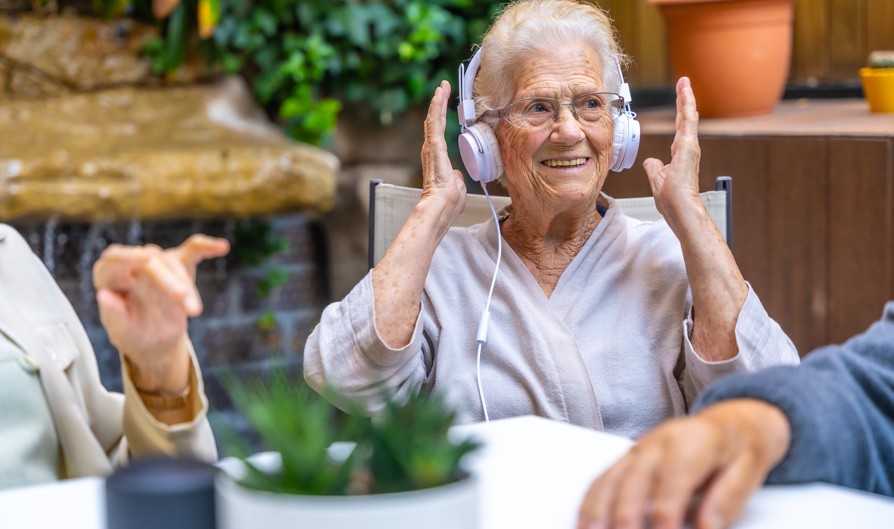
What often changes first is not volume alone, but clarity. Age-related hearing loss can make speech harder to understand, especially in noisy settings or group conversations. The person may hear that someone is speaking, but miss key words or fill them in incorrectly.
Research supported by the National Institute on Deafness and Other Communication Disorders notes that aging can interfere with hearing speech in noisy environments, which helps explain why restaurants, family gatherings, and waiting rooms often become more tiring than before (National Institute on Deafness and Other Communication Disorders [NIDCD], 2023).
Here are some of the patterns worth noticing early.
- Conversation starts needing repair
One of the first clues is frequent repair inside normal conversation.
You may hear:
- “Can you say that again?”
- “I missed the last part.”
- “People are mumbling.”
- “Everyone talks too fast.”
This matters because repetition is not always random. When it starts appearing in similar situations over and over, it usually points to a listening pattern that has changed. The NIA lists asking people to repeat themselves and thinking others are mumbling among the common signs of hearing loss in older adults (NIA, 2023).
Example:
At lunch, your mother follows the first part of the conversation, then loses the thread when two people speak close together. She is still engaged. She just cannot catch every layer at the same speed.
- Group settings become more demanding
Many older adults still do reasonably well in a quiet one-on-one conversation. The difficulty becomes more visible in places where voices compete with background noise.
Families may notice:
- less participation at the table
- shorter answers
- nodding without fully responding
- visible fatigue after social gatherings
This pattern makes sense clinically. Older adults with hearing loss often struggle more when several people are talking or when speech competes with surrounding noise (NIA, 2023; NIDCD, 2023).
Example:
A grandfather who used to enjoy long family meals now seems quieter halfway through dinner. He may still want to be there. The effort of decoding fragmented speech has simply increased.
- Volume rises, but understanding does not improve
The television is often where families notice the shift first. The volume goes up. Captions become permanent. Phone calls become less comfortable. Yet even with louder sound, understanding may still remain uneven.
That detail is useful because hearing changes are not always solved by amplification alone. Higher-pitched sounds and speech details may become harder to process with age, which is one reason dialogue can sound audible but still feel blurred (NIA, 2023).
Example:
The TV is loud enough for everyone in the room, but your father still asks what a character said. The issue is no longer just loudness. It is precision.
- Small misunderstandings begin to accumulate
This is where hearing changes start affecting daily function more clearly.
Look for moments like these:
- hearing “Tuesday” instead of “Thursday”
- missing part of a medication instruction
- misunderstanding a time, address, or appointment detail
- answering a different question than the one asked
The NIA notes that hearing loss can interfere with understanding medical advice, warnings, alarms, and everyday communication, which gives these small errors more weight than they may seem to have at first glance (NIA, 2023).
- Social style changes for reasons that are easy to misread
Sometimes the first visible shift is behavioral. A person leaves the table earlier. Avoids calls. Speaks less in groups. Seems present, but less verbally active.
Families may interpret this as mood, aging, distraction, or personality change. In many cases, conversation has simply become more effortful. The NIA notes that untreated hearing loss can make older adults feel more isolated because everyday interaction becomes harder to sustain (NIA, 2023).
A useful question here is simple: Is the person less interested in connection, or is connection taking more work than before?
What families should pay attention to
A single missed sentence proves very little. A repeated pattern tells a much more intelligent story.
Pay attention when the same conditions keep showing up:
- noise makes comprehension drop sharply
- repetition becomes frequent
- group settings feel exhausting
- volume increases without better understanding
- the person participates less because listening has become work
The CDC also recommends practical communication adjustments that reveal a lot on their own: reduce background noise, speak clearly, and talk face to face. When those changes noticeably improve comprehension, families are often seeing the problem more clearly than they realize (Centers for Disease Control and Prevention [CDC], 2024).
A good way to open the conversation is with observation, not correction.
For example:
- “I’ve noticed group conversations seem more tiring lately.”
- “Restaurants look harder than they used to.”
- “It seems like you hear the sound, but not always every word.”
That kind of language preserves dignity. It names the pattern without dramatizing it.
What Can Actually Help Protect Hearing in Older Adults
Start with a simple question
Before doing anything else, ask:
Is this a hearing issue, a clarity issue, an environment issue, or a care issue?
That question changes everything.
Sometimes the person hears sound, but not speech clearly. Sometimes the room is too noisy. Sometimes wax, medication changes, or a health condition is adding friction. Sometimes the family has normalized a pattern that already deserves attention.
- Lower the noise load around important moments
One of the smartest ways to protect hearing is also one of the least glamorous. Stop letting important conversations compete with background noise.
Use this rule:
If the information matters, the sound environment matters too.
That means:
- turn off the TV before discussing medications, appointments, or plans
- lower music during meals
- avoid giving important information from another room
- choose quieter restaurants when possible
- sit where the older adult can clearly see the speaker’s face
Example:
If your mother always seems confused about appointment times, the issue may not be memory first. It may be that those details are always being mentioned while dishes are clattering, the TV is on, or several people are talking.
- Treat volume as a clue, not a solution
Many families respond to hearing changes by simply speaking louder. That helps sometimes, but it can also miss the real problem.
A better checklist is this:
- Is the TV volume steadily going up?
- Does the person still miss words even when things are louder?
- Are phone calls harder than face-to-face conversation?
- Do group settings feel harder than quiet one-on-one moments?
If the answer is yes, the issue may be speech clarity, not only loudness. Age-related hearing loss often makes it harder to distinguish words, especially in noise or when speech is fast (NIA, 2023; NIDCD, 2023).
What to do next:
Do not just raise the volume. Slow the pace, face the person, reduce competing sound, and pay attention to patterns.
- Build a “hearing-friendly” home routine
Small routine changes can protect more communication than most families expect.
Try these:
- speak face to face for important conversations
- make sure only one person speaks at a time during meals
- use captions on TV even if hearing aids are not in the picture yet
- keep lighting good so facial cues are easier to read
- save more demanding conversations for calmer times of day
CDC guidance for communicating with older adults supports exactly these kinds of changes, especially reducing background noise and speaking clearly face to face.
This may sound simple, but it is the kind of simple that changes daily life.
- Look beyond the ear itself
This is where families often miss useful opportunities.
Hearing is influenced by more than age alone. High blood pressure, diabetes, and some medications are associated with hearing problems, which means hearing deserves a place in broader health conversations, not just in a specialist’s office (NIDCD, 2023).

A very practical move is to ask these questions during regular care:
- Have there been any recent medication changes?
- Has blood pressure been stable?
- Is diabetes well controlled?
- Has anyone checked whether wax buildup is part of the issue?
- Has the person mentioned ringing, muffled hearing, or sudden changes?
Useful mindset:
Do not separate hearing from the rest of health. Put it back into the full picture.
- Keep ear protection where real life happens
People often think ear protection is only for concerts or construction. In real life, repeated exposure also comes from leaf blowers, power tools, loud fitness classes, sporting events, fireworks, and even long periods of high earbud volume.
A much smarter habit is to make protection easy to reach:
- keep earplugs in the car
- keep another pair near gardening or workshop tools
- pack them for travel, festivals, or crowded events
- use them before the environment feels uncomfortable
That kind of preparation works better than telling someone to “be careful” after the fact.
- Know what deserves fast attention
Families should not panic over every missed word. They should know when a hearing change has crossed into “do not wait.”
Take quicker action if:
- one ear suddenly seems blocked or much weaker
- hearing drops noticeably over days, not years
- ringing becomes intense and new
- dizziness or imbalance appears with the hearing change
- understanding speech drops sharply without an obvious reason
Sudden hearing loss can be mistaken for something minor, but fast evaluation matters because treatment is more time-sensitive in those cases (NIDCD, 2018).
- Stop waiting for the problem to become “serious enough”
Many families delay support because the person is still managing “well enough.” That phrase can hide a lot of unnecessary strain.
A better threshold is this:
If hearing changes are making daily life more effortful, the issue already deserves attention.
That may mean:
- scheduling a hearing test
- asking a primary care provider where to start
- exploring whether OTC hearing aids are appropriate for mild to moderate difficulty
- using captions, visual alerts, or better phone settings sooner rather than later
The best support usually starts before frustration turns into withdrawal.
A practical family plan
If you want to keep this section feeling like a guide, this is the most useful takeaway:
This week
- notice when hearing seems hardest
- reduce background noise during important conversations
- check whether TV or phone volume has changed
This month
- bring up hearing during a regular medical visit
- review medications and overall health factors
- schedule a hearing check if patterns keep repeating
Going forward
- make the home easier for conversation
- protect ears during louder activities
- act early when changes become consistent
That is usually how hearing gets protected in real life. Not through one dramatic fix. Through early pattern recognition, smarter environments, and less daily friction.
References
Centers for Disease Control and Prevention. (2024, October 16). Challenges affecting health literacy of older adults. U.S. Department of Health and Human Services.
National Institute on Aging. (2023, January 19). Hearing loss: A common problem for older adults. U.S. Department of Health and Human Services, National Institutes of Health.
National Institute on Deafness and Other Communication Disorders. (2018, September 14). Sudden sensorineural hearing loss (sudden deafness). U.S. Department of Health and Human Services, National Institutes of Health.
National Institute on Deafness and Other Communication Disorders. (2023, March 17). Age-related hearing loss (presbycusis). U.S. Department of Health and Human Services, National Institutes of Health.