








What if the biggest cost of waiting to plan for senior living is something your family hasn’t considered yet?
Most families don’t postpone planning because they lack concern. Often, they postpone it because life still seems manageable. A parent is living independently, family members are helping when needed, and there is no obvious reason to make a change.
But there’s a question worth considering: How much of that independence depends on support that no one is actually measuring?
Think about the arrangements that gradually become part of everyday life:
- The invisible workload: One family member starts managing appointments, medications, groceries, or household responsibilities without formally becoming a caregiver.
- The financial blind spot: Families compare the monthly cost of senior living without calculating home maintenance, transportation, outside assistance, or time away from work.
- The independence paradox: Remaining at home may preserve familiar routines, even as certain activities become harder to manage without help.
- The decision-making gap: Everyone assumes there will be time to discuss future preferences, yet no one has established what those preferences actually are.
These situations raise an important distinction: Being comfortable with today’s arrangements doesn’t necessarily mean being prepared for tomorrow’s needs.

A Quick Family Reality Check
How many of these questions can your family confidently answer?
Do we know how much informal family support is currently required?
Have we compared the full cost of staying at home with other living options?
Do we know what we would do if additional support became necessary?
Have we discussed which aspects of independence matter most to our loved one?
The Economics of Aging: What Are Families Overlooking?
Consider a familiar situation. An older parent lives independently, manages most daily activities, and occasionally receives help from family members. Someone drives them to appointments. Another person handles groceries. A daughter gradually takes responsibility for medications, household paperwork, or financial decisions.
Individually, these arrangements seem insignificant. Collectively, they can become an informal caregiving system sustained by resources that rarely appear in a household budget.
Economists call this opportunity cost: the value of what we give up when choosing one course of action over another. In senior living planning, that concept raises four questions families frequently overlook:
- The cost of time: How many hours are family members investing in support, and what other responsibilities compete for that time?
- The cost of uncertainty: What happens when future care needs, financial arrangements, and personal preferences remain undefined?
- The cost of limited choices: Could an unexpected change reduce the time available to evaluate communities, compare services, and make informed decisions?
- The cost of missed opportunities: Does the current living arrangement still support the independence, relationships, and experiences an older adult values?
The Numbers Behind the Invisible Work
According to AARP’s 2026 research, approximately 59 million Americans caring for adults provided 49.5 billion hours of support in 2024, representing an estimated economic value exceeding $1 trillion.
Another study from A Place for Mom reveals a significant planning gap: 77% of caregivers who had not begun searching for professional care, or were just starting, expected to have several months or longer before needing it. Yet among caregivers who ultimately arranged care, 69% did so within 60 days.
Although these figures describe different groups and measures, together they highlight an important consideration: family caregiving requires substantial resources, and the time available to make decisions may be shorter than anticipated.
The Family Reality Check
Before comparing senior living options, take a moment to evaluate the support system already in place.
How many of these questions can your family answer confidently?
- Time: Do we know how many hours family members dedicate to caregiving each week?
- Finances: Have we calculated our current housing, transportation, household maintenance, and caregiving expenses?
- Independence: Have we discussed which daily activities and personal freedoms matter most to our loved one?
- Preparedness: Could we identify and compare appropriate senior living options if additional support became necessary within 30 days?
One question worth discussing: If the family member providing the most assistance became unavailable tomorrow, how would the current arrangement change?
This exercise reveals another concept from behavioral economics: status quo bias, our tendency to prefer familiar circumstances, even when alternatives deserve consideration.
In aging-related decisions, familiarity can make the immediate expense of moving appear especially significant, while the ongoing costs of remaining at home receive less scrutiny.
That does not mean moving is always the better financial or personal choice. Remaining at home with appropriate support may be ideal for many older adults. Independent Living or Assisted Living may better meet the needs and preferences of others.
The most useful comparison begins with a different question: What resources does our current lifestyle require, and how well will that arrangement support our needs over time?
Understanding these factors gives families a clearer foundation for evaluating future choices, including how planning timelines, financial considerations, and personal independence influence one another.
How Does a Planned Decision Compare to a Crisis-Driven One?
Time is one of the least discussed resources in senior living planning.
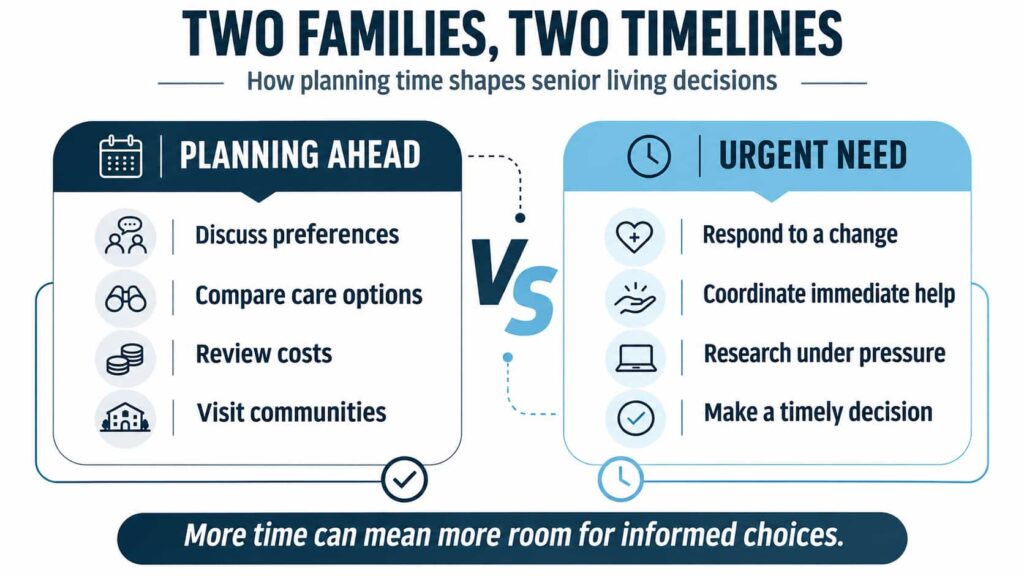
When families begin researching options early, they may have opportunities to compare living arrangements, understand expenses, visit communities, and discuss personal preferences.
When an unexpected event accelerates the process, those same decisions may need to happen within a much shorter period.
Two Families, Two Decision-Making Timelines
Family A: Planning Before Support Becomes Urgent
- Discusses future preferences with their parent.
- Reviews financial resources and potential care expenses.
- Explores Independent Living and Assisted Living communities.
- Visits several locations and evaluates their services.
- Establishes a plan for changing needs.
Family B: Beginning After an Unexpected Change
- Must identify appropriate support quickly.
- Coordinates immediate responsibilities among relatives.
- Researches unfamiliar care options under time pressure.
- Evaluates expenses while managing other urgent decisions.
- May have fewer available choices within the required timeline.
These are illustrative scenarios, and planning cannot eliminate every unexpected event. It can, however, help families establish a clearer understanding of their options before circumstances change.
The Decision-Making Question
Would your family make the same choice with six months to evaluate options as it would with six days?
Consider which factors might receive less attention under pressure:
- An older adult’s personal preferences
- Location and proximity to family
- Lifestyle and social opportunities
- Levels of assistance available
- Monthly expenses and additional charges
- Policies for changing care needs
The National Institute on Aging encourages families to consider support needs and housing options before extensive assistance becomes necessary.
Can Planning Earlier Actually Create More Freedom?
One of the most important questions in aging is how to preserve personal autonomy as circumstances evolve.
For many older adults, independence means maintaining control over daily routines, relationships, living arrangements, and personal decisions.
Planning can support that autonomy by creating opportunities to express preferences before an urgent situation requires action.
The Independence Conversation
Ask the older adult whose future is being discussed:
Which three aspects of your daily life matter most to you?
Possible answers might include:
- Choosing how to spend each day
- Staying close to friends and family
- Maintaining familiar hobbies and interests
- Having privacy and personal space
- Feeling confident about everyday safety
- Having assistance available when needed
Use those answers to guide the search.
For example, an older adult who values social opportunities and freedom from household responsibilities may wish to explore Independent Living. Someone who needs regular assistance with daily activities may benefit from evaluating Assisted Living.
There is no universal answer. The goal is to understand which living arrangement best supports the individual’s priorities and needs.
Your First Three Steps Toward a Thoughtful Plan
Step 1: Understand the present.
Document current responsibilities, support needs, living expenses, and personal preferences.
Step 2: Explore the possibilities.
Learn about Independent Living, Assisted Living, Memory Care, and other support arrangements. Compare the services, costs, and lifestyle considerations relevant to your family.
Step 3: Create a flexible plan.
Discuss potential changes, identify helpful resources, and revisit decisions as circumstances evolve.
One Final Question
If you could give your future self one advantage when facing an important decision about aging, would it be more money, more information, or more time?
Each can make a difference. Thoughtful planning creates an opportunity to understand how all three work together.
At Atlas Senior Living, we believe that exploring future living options should begin with understanding what matters most to each individual. Learning about Independent Living, Assisted Living, and Memory Care can be a practical first step toward making informed decisions with greater confidence.
Explore Atlas Senior Living communities and find the support, lifestyle, and opportunities that align with your family’s priorities.